The Quiet Strain at the Checkpoint
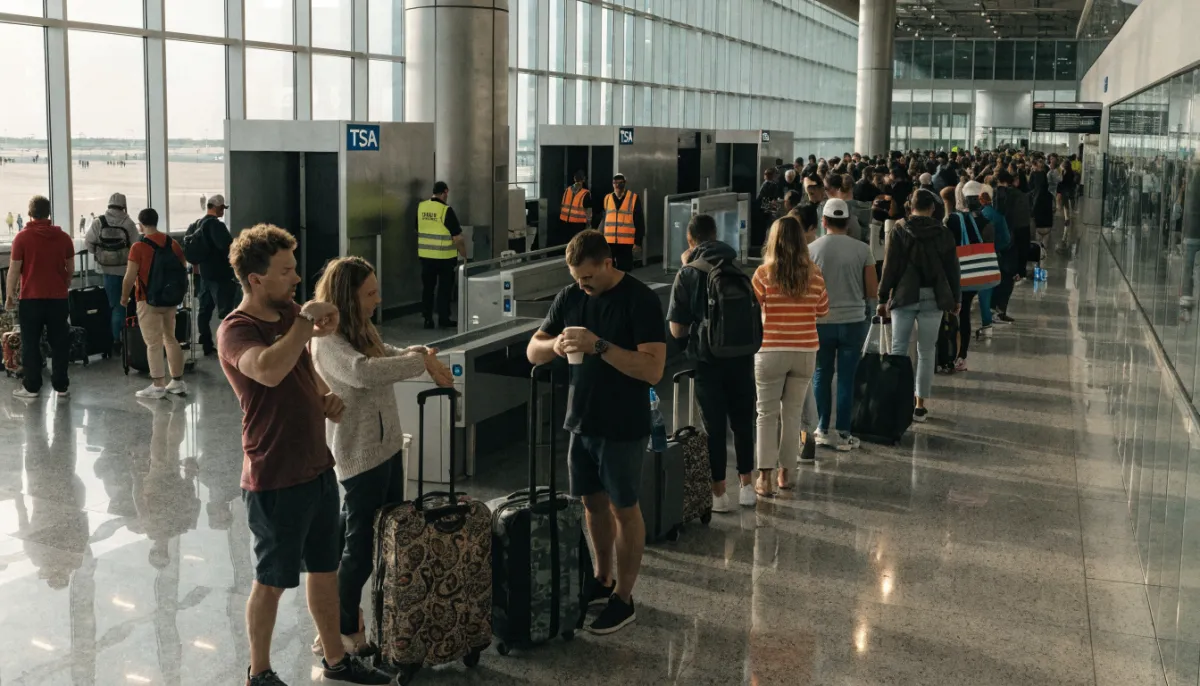
It started with the small details travelers notice first: the lengthening queues snaking through terminals, the announcements urging people to arrive earlier than usual, the quiet frustration in the eyes of those who had already missed their flights. At Houston's William P. Hobby Airport on March 14, more than half the TSA officers called out sick. By the following week, checkpoints were consolidating at Atlanta, New Orleans, and Philadelphia, with lines stretching beyond three hours in some places. The partial shutdown of the Department of Homeland Security, which began in mid-February, had been a distant political story for most Americans until it reached the security line.
TSA officers have now gone without pay for weeks, some for the third time in six months. Reports describe people sleeping in their cars between shifts or donating plasma to cover gas money. Over 366 have quit since the impasse began, and training replacements takes four to six months. The numbers are not abstract. A typical call-out rate hovers around 2 percent; recently it has climbed above 10 percent nationally and spiked much higher at certain airports.
Acting Deputy Administrator Adam Stahl put it plainly: the agency cannot sustain these losses. When staffing drops, lanes close, then entire checkpoints. Philadelphia International began shutting three of its six main screening areas this week to concentrate what manpower remained. Smaller airports lack the buffer to absorb such absences, raising the possibility of full closures if the situation persists.
The security implications sit uneasily beneath the inconvenience. Fewer officers mean slower, more crowded screening. Passengers are funneled into fewer lanes, increasing the chance that something is missed or that frustration boils over. Stahl and others have spoken of a "serious situation" involving not just numbers but threat assessments that shift with the flow of travelers. Airlines have begun warning of higher fares to offset the cascading delays, while international warnings from the UK and EU about potential disruptions hint at broader economic ripples. Tourism, conferences, family visits—all of it quietly recalibrating around the bottleneck at the gate.
What makes the episode notable is how ordinary the underlying mechanics are. Large systems that depend on human labor tend to fray when that labor goes unpaid for extended periods. Incentives align in predictable ways: people choose rent over commuting, stability over uncertainty. Congress remains locked in debate over funding tied to larger immigration questions, each side framing the other as responsible for the impasse. Democrats call it a manufactured crisis; Republicans point to the need for broader reforms. Both perspectives contain pieces of truth, yet neither fully accounts for the officers deciding whether they can afford to show up tomorrow.
The shutdown is not new territory—similar strains appeared in previous budget standoffs—but the accumulated fatigue seems different this time. Repeated cycles of uncertainty wear on the workforce in ways that statistics only partly capture. Attrition climbed 25 percent at some sites during the last episode; current trends suggest the pattern is repeating, if not accelerating.
Travelers, for their part, are adapting in small, practical ways. Apps that track wait times are seeing heavier use. Some are choosing earlier flights or different routes. The deeper question is what happens if the political deadlock stretches into spring travel season, when volumes rise and patience thins. There is no elegant fix visible in the immediate term. Funding would ease the pressure, but the underlying tensions that produced the shutdown would remain. Training pipelines cannot be accelerated overnight. Trust between workers and the institutions that employ them erodes gradually, then suddenly shows up in the form of closed lanes and international advisories.
In the end, the scene at the airport captures something basic about how these systems actually function. They run on people who show up, day after day, often without fanfare. When those people calculate that showing up no longer makes sense, the effects surface not in grand policy statements but in the ordinary friction of daily life—missed connections, longer goodbyes, a subtle reordering of expectations about what we can count on. The checkpoints may reopen fully when the checks start arriving again. The harder part is measuring what has already been lost in the meantime.