Middle East Conflict Causes Widespread Flight Cancellations and Travel Chaos
By Becky Wanders
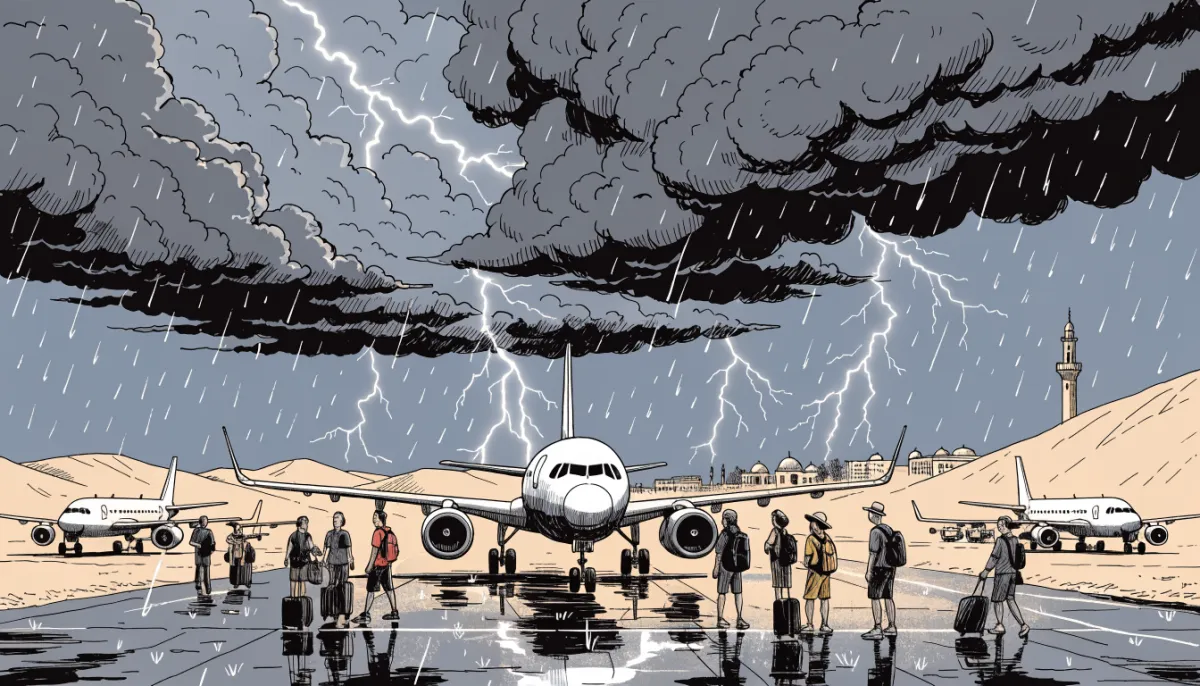
The skies over the Middle East have gone eerily quiet. In the wake of escalating geopolitical conflict involving the U.S., Israel, and Iran, airlines have canceled thousands of flights, closed key airspaces, and left travelers scrambling for ways home or rethinking their spring and summer plans entirely.
Hundreds of thousands of passengers have been affected as major aviation hubs in the Gulf — Dubai, Abu Dhabi, Doha, and others — operate under heavy restrictions. Repatriation flights run around the clock in some cases, while others see entire schedules wiped clean into late 2026. What began as a regional security issue has rippled outward, pushing up fuel prices and threatening to raise airfares globally.
This is the new reality for anyone with tickets to or through the Middle East right now.
The current disruptions trace back to strikes in late February 2026 that triggered immediate airspace closures and a cascade of cancellations. By early March, the situation had stabilized somewhat in certain corridors but remained unpredictable. Major news organizations tracked the chaos closely, with The New York Times even issuing a reader callout on March 12 asking how the events were affecting travel plans.
Airlines responded by extending cancellations weeks or months out. Emirates, Qatar Airways, British Airways, and others issued notices affecting routes across Europe, Asia, and Africa. Some carriers rerouted flights over safer paths, adding hours to journey times and increasing operational costs.
Travelers already in the region reported sudden changes. Cruises that called on regional ports had itineraries truncated or redirected. Tour groups found themselves stuck waiting for rare available seats. Private jet companies saw a spike in last-minute charters from those who could afford them.
Aviation analysts estimate 20,000 to 30,000 flights have been canceled so far, impacting well over a million passengers. Fuel price volatility adds another layer: higher costs for carriers could translate to higher fares even on unaffected routes later this year.
Safety advisories from governments around the world remain in place. Many recommend avoiding non-essential travel to several Middle Eastern countries, with some extending warnings to neighboring states where overflights have become risky. Insurance providers have activated clauses for conflict zones, leaving some travelers without coverage for cancellation or medical emergencies.
For those who must travel, alternatives are limited and expensive. Overland routes through Turkey or Jordan see increased demand, though these come with their own security concerns and longer transit times. Some opt for connecting flights through safer hubs like Istanbul, Athens, or even further afield in Europe.
The tourism industry across the region is feeling the pain. Hotels report sharp drops in occupancy for the typically busy spring shoulder season. Heritage sites that usually draw crowds now stand quieter. Local guides and small businesses dependent on international visitors are bracing for lean months ahead.
Yet the situation is not uniform. Some Gulf states continue limited operations and have stepped up diplomatic and operational efforts to keep key airports functioning as transit points. Airlines serving these routes emphasize enhanced security protocols and flexibility for passengers.
Looking at historical parallels, this isn't the first time conflict has upended Middle Eastern aviation. The 1991 Gulf War, the 2003 Iraq invasion, and various flare-ups since have all caused similar spikes in cancellations and rerouting. What feels different this time is the speed of modern information — travelers learned of changes almost in real time through airline apps and social media — and the broader integration of Gulf hubs into global networks.
Today's traveler faces a more connected but more fragile system. A conflict in one area quickly affects booking patterns worldwide. Data from the first week of March already showed softening demand for summer travel to Europe and Asia, as some passengers delay or cancel trips that would have crossed sensitive airspace.
What should travelers do?
First, check directly with your airline rather than relying on booking platforms. Many are offering waivers for rebooking or full refunds without penalty. Travel insurance purchased before the escalation may provide some protection, but review your policy carefully for war and conflict exclusions.
Second, build flexibility into your plans. Consider destinations further from current hotspots — perhaps the Balkans, Portugal, or Southeast Asian countries that offer similar cultural or beach experiences without the current risks.
Third, stay informed through official sources. The U.S. State Department, UK Foreign Office, and other foreign ministries update advisories frequently. Aviation authorities like the FAA and EASA also issue notices to airmen that detail closed airspaces.
For those already booked, consider travel protection services or credit card benefits that offer trip delay or cancellation coverage.
The human stories emerging from this chaos bring home the personal cost. Families separated by canceled flights. Business travelers stuck for weeks. Tourists who saved for a once-in-a-lifetime trip to Petra or the Pyramids now watching their plans dissolve.
One traveler quoted in recent coverage described arriving at Dubai airport only to find their onward flight canceled and no seats available for days. Another spoke of rerouting through three extra countries to reach their destination, turning a 12-hour journey into nearly 40 hours.
These disruptions arrive at a delicate time for the travel industry. After years of recovery from the COVID pandemic, many carriers and destinations were finally seeing strong 2026 bookings. The uncertainty now risks dampening that momentum not just in the Middle East but in connected markets.
Forward-looking implications are significant. Prolonged instability could accelerate diversification of air routes away from traditional Middle Eastern hubs. Airlines may invest more heavily in polar or northern routes for Europe-Asia traffic. Tourism boards in unaffected regions are already positioning themselves as safe alternatives.
Yet the Middle East's cultural and historical riches remain powerful draws. When stability returns — and history suggests it eventually does, at least temporarily — pent-up demand could bring a strong rebound. The question is how long that recovery will take and what the landscape will look like.
In the meantime, travelers are adapting. Some pivot to domestic or nearby getaways. Others monitor the situation closely, ready to book the moment advisories lift. A few embrace the uncertainty as part of the adventure, though most simply want reliable information and reasonable options.
The current air travel chaos in the Middle East serves as a reminder of how tightly woven global mobility is with geopolitics. What happens in one region no longer stays there. A strike in the desert can cancel your flight in Chicago or Sydney.
For now, flexibility, vigilance, and realistic expectations are the best tools in any traveler's kit. Check your bookings. Read the advisories. Have a backup plan. And perhaps dream of the day when the skies over the region reopen to curious wanderers once more.
Sources
- https://www.nytimes.com/2026/03/12/travel/2026-travel-plans-iran-war-shutdown.html
- https://www.cntraveler.com/story/what-travelers-need-to-know-about-middle-east-flight-disruptions
- https://www.theguardian.com/world/2026/mar/02/flights-cancelled-middle-east-travel-chaos-us-israeli-iran-conflictflights-cancelled-middle-east-travel-chaos-us-israeli-iran-conflict
- https://beabettertraveler.substack.com/p/travel-news-to-know-march-13-2026
- https://www.nytimes.com/interactive/2026/03/12/business/iran-war-flight-diversions.html